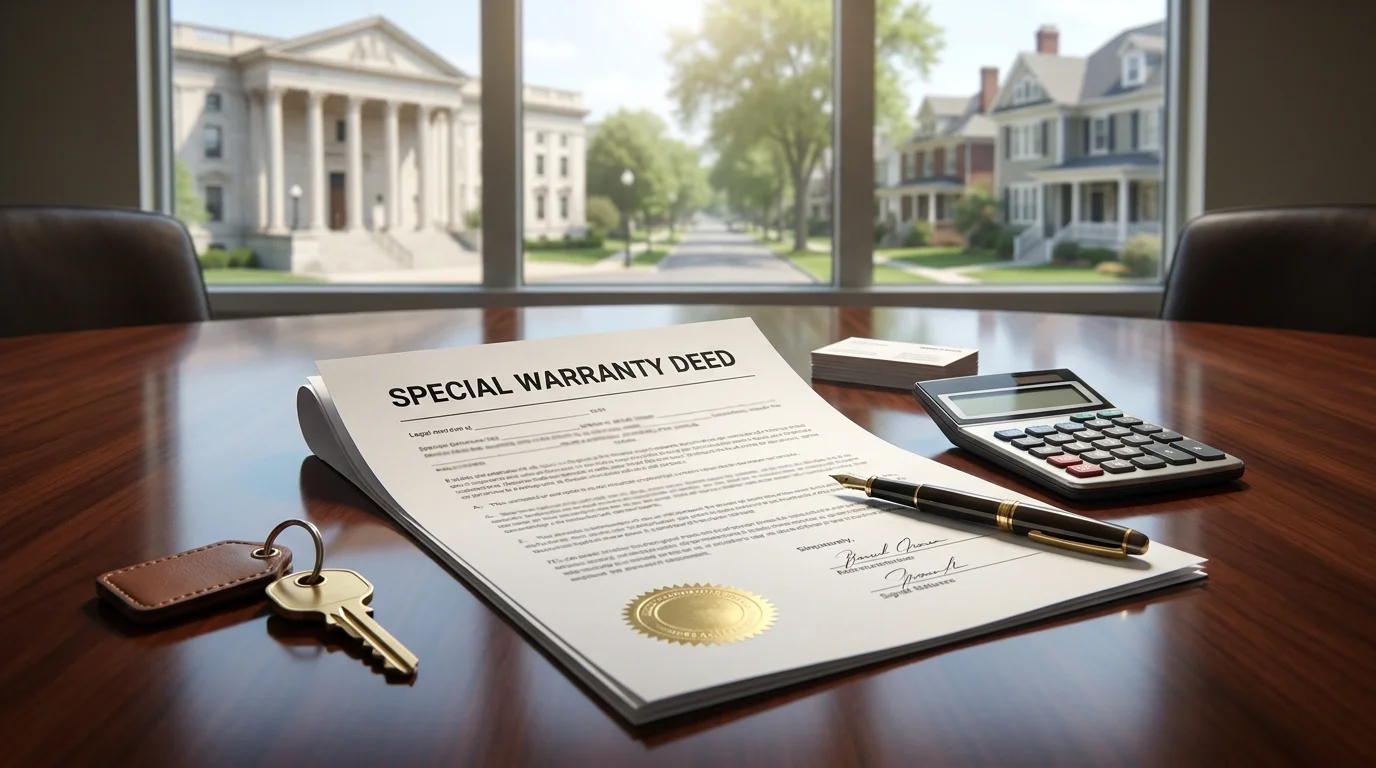
A special warranty deed can look reassuring because it contains a warranty, but that warranty is narrower than many homebuyers expect. Instead of protecting the buyer against title problems throughout the property’s entire history, it generally limits the seller’s promise to problems connected with the period when that seller owned the property. Understanding that limitation matters before a buyer accepts the deed at a residential, commercial, investment, or other real estate closing.
Direct answer: This deed transfers real estate while limiting the seller’s title warranty to problems that arose during the seller’s ownership. It does not protect the buyer against defects created by earlier owners. U.S. buyers often use a title search and owner’s title insurance to address that earlier-title risk.
The American Bar Association describes a special or limited warranty deed as providing less extensive protection than a general warranty deed because the grantor warrants against claims arising during the grantor’s ownership rather than earlier claims. The exact deed name, wording, signing requirements, and legal effect can differ by state, however, because real estate conveyancing and recording are governed largely by state and local law.
What Is a Special Warranty Deed?
This type of deed is a document used to transfer an interest in real property from a grantor, usually the seller, to a grantee, usually the buyer. Its distinguishing feature is the limited scope of the grantor’s title warranties rather than the mere transfer of ownership itself. Cornell Law School’s Legal Information Institute explains that the grantor generally warrants against title defects occurring during the grantor’s ownership but not defects that existed before that ownership began.
This warranty concerns title, not whether the house, building, or land is physically free from defects. In other words, receiving this deed does not, by itself, guarantee that the roof is sound, the plumbing works, the foundation has no problems, or the property complies with all building requirements. Buyers should treat property inspections, contractual condition disclosures, title review, and deed warranties as related but separate parts of due diligence.
The term can also vary geographically. The ABA notes that this instrument may be called a limited warranty deed, while some states use different deed terminology and statutory language. Buyers should therefore focus on the actual warranties written or implied in the deed under the law of the state where the real estate is located, rather than relying exclusively on the document’s heading.
What Does a Limited Warranty Deed Actually Protect Against?
The central promise is limited by time and by the grantor’s connection to a title problem. If an undisclosed lien, competing conveyance, or other covered defect arose through the grantor while the grantor owned the property, the warranty may give the grantee a contractual basis for seeking a remedy. The precise covenants and available remedies depend on the language of the deed and applicable state law.
Texas provides a useful illustration of how this limitation can appear in practice. The Texas Department of Transportation’s special-warranty language limits the warranty to people claiming the property “by, through, or under Grantor, but not otherwise,” rather than extending responsibility to the entire prior chain of title. Texas law also permits parties to use conveyance clauses that are not contrary to law, illustrating why deed wording deserves careful review.
Suppose, for example, that a seller owned a building from 2022 through 2026 and granted an undisclosed interest in the property during 2024. A limited warranty could address a covered claim arising from the seller’s conduct because the problem developed during the seller’s ownership period. If the title problem instead originated with an owner in 2005, however, the special warranty generally would not make the 2026 seller responsible merely because the seller later transferred the property.
Special Warranty vs. General Warranty Deed
The main difference between a general and a limited warranty deed is the scope of the seller’s title promise. A general warranty normally reaches claims arising both before and during the grantor’s ownership, while a special warranty limits the grantor’s responsibility to a narrower period. The ABA identifies this coverage period as the central distinction between the two forms.
| Issue | General Warranty Deed | Limited Warranty Deed |
|---|---|---|
| Transfers real property | Yes | Yes |
| Seller gives title warranties | Yes | Yes, but limited |
| Claims arising during seller’s ownership | Generally covered | Generally covered |
| Claims predating seller’s ownership | Generally covered by seller’s warranty | Generally not covered by seller’s warranty |
| Seller’s potential title liability | Broader | Narrower |
| Buyer due diligence still important | Yes | Yes |
A general warranty can therefore provide a buyer with broader contractual recourse against the grantor. That does not mean every buyer should automatically reject a special warranty, because deed choice is only one part of the transaction’s risk allocation. The purchase contract, title commitment, title insurance, exceptions, seller identity, transaction history, and applicable state law can all affect the real level of protection.
Limited Warranty Deed vs. Quitclaim Deed
A quitclaim deed provides even less assurance than a limited warranty deed. Cornell explains that a quitclaim generally conveys whatever interest the grantor has, if any, without promising that the grantor holds clean title, while a special warranty does contain limited title protection tied to the grantor’s ownership. That distinction places a special warranty between the broader protection of a general warranty deed and the lack of title warranties associated with a quitclaim.
| Feature | Limited Warranty Deed | Quitclaim Deed |
|---|---|---|
| Transfers grantor’s property interest | Yes | Yes |
| Contains title warranties | Limited warranties | Generally none |
| Protects against some grantor-created title problems | Potentially, depending on deed and state law | Generally no warranty protection |
| Covers older title defects | Generally no | No warranty |
| Often requires careful title review | Yes | Yes |
The distinction becomes especially important when money is changing hands in an arm’s-length purchase. Buyers should not assume that two deeds are equivalent simply because both can transfer an interest in land. The warranties written into the instrument can determine whether the buyer later has a deed-based claim against the grantor when a covered title defect emerges.
Why Are Limited Warranty Deeds Used?
Limited warranty deeds are particularly familiar in commercial real estate. Cornell notes that they are very common in commercial transactions, where parties frequently rely on title insurance and negotiated closing documents in addition to the deed itself. The American Bar Association has likewise discussed limited and special warranty conveyances in commercial purchase transactions and in the broader allocation of title risk among buyers, sellers, and title insurers.
A seller may prefer this form because they do not want to accept responsibility for events that occurred before acquiring the property. That concern can be especially understandable when a corporation, fiduciary, financial institution, estate representative, or other owner has limited knowledge of a property’s earlier history. The buyer, however, needs to understand exactly which historical risks the seller is declining to warrant.
Investors should consider the deed alongside the economics of the entire acquisition rather than treating it as a minor closing form. Ventweek readers evaluating a rental or investment purchase can also review the site’s discussion of investment property down payments, because financing, cash reserves, title costs, and acquisition risk should be evaluated together. A low purchase price does not automatically compensate for weak due diligence when a title dispute could threaten the investment later.
Does This Type of Deed Mean the Title Is Bad?
No, the use of this deed does not automatically mean that the property has defective title. It primarily tells the buyer that the grantor is limiting the scope of the warranties being provided, which is a risk-allocation decision rather than proof that a specific defect already exists. A property conveyed this way can still have a thoroughly researched and insurable chain of title.
At the same time, buyers should not interpret the word “warranty” as proof that the entire historical title has been guaranteed by the seller. A title search may reveal mortgages, liens, easements, judgments, restrictions, prior conveyances, or other recorded interests that deserve attention before closing. Recording systems themselves do not guarantee the accuracy of every recorded claim, which is why title professionals examine the chain of title rather than merely confirming that a deed appears in public records.
That broader review is especially important when competing offers or a fast closing creates pressure to move quickly. Ventweek’s guide to evaluating the highest and best offer in a home sale explains why purchase terms matter in addition to the headline price. The same principle applies to deeds: a strong price does not eliminate the need to understand exactly what title protection the closing documents provide.
Why Title Insurance Matters With a Limited Warranty

Title insurance and a deed warranty are not the same protection. The deed establishes promises between the parties according to its terms and governing law, while an owner’s title insurance policy can protect the homeowner financially against specified covered title claims. Consumer Financial Protection Bureau guidance on optional owner title insurance states that owner’s title insurance can provide protection when someone later asserts a claim against the home based on an issue from before the homeowner bought it.
That historical protection can be especially relevant when the seller’s deed warranty stops at the beginning of the seller’s own ownership period. A title insurer ordinarily conducts or relies on title examination and then issues coverage subject to exclusions, exceptions, policy conditions, and the terms of the particular policy. Buyers should therefore read the title commitment and final policy rather than assuming the insurance covers every conceivable dispute.
Mortgage borrowers should also distinguish between lender’s and owner’s title insurance. The CFPB guidance on lender title insurance states that lender’s title insurance protects the lender’s interest and is usually required with a mortgage, whereas an owner’s policy protects the homeowner’s financial investment. Having a lender’s policy consequently does not mean the buyer’s own equity has identical coverage.
What Buyers Should Check Before Accepting the Deed
A buyer should review more than the title printed across the top of the document. The exact warranty clause, legal description, named grantor and grantee, exceptions, reservations, title commitment, survey issues, and recording requirements can all affect the transaction. Because requirements vary by state and county, a locally licensed real estate attorney, title company, or qualified closing professional should review questions specific to the property.
Before closing, consider checking:
- Whether the deed is actually described as a special, limited, grant, or another state-specific deed.
- The exact language defining which claims the grantor agrees to warrant against.
- The property’s complete legal description rather than relying only on a street address.
- Existing mortgages, tax liens, judgments, easements, restrictions, and other title exceptions.
- Whether a current title search has been completed.
- What the owner’s title insurance policy covers and specifically excludes.
- Whether the seller must clear identified title problems before closing.
- The state’s signature, acknowledgment, witnessing, notarization, transfer tax, and recording requirements.
- Whether the purchase agreement promised a different type of deed than the seller proposes to deliver.
- Whether an attorney should review unusual circumstances involving ownership, estate, divorce, trust, entity, or foreclosure.
These steps matter because recording rules are jurisdiction-specific. Cornell describes recording as filing a deed or other property-interest document with the appropriate recording office, noting that each jurisdiction’s recording act establishes its requirements. Recording also provides important public notice, but the act of recording alone does not guarantee that every underlying title claim is valid.
What Sellers Should Understand
For sellers, this form of deed can reduce the scope of title responsibility compared with a general warranty. That limitation does not mean the seller is free to ignore problems created during the seller’s ownership, nor does it automatically override obligations contained in a purchase agreement or other closing documents. Sellers should ensure that the deed delivered matches what they agreed to provide under the contract.
The exact warranty wording matters more than informal descriptions exchanged during negotiations. An ABA discussion of deed law highlights how statutory language and the document’s substance can matter when deciding whether particular warranty covenants arise, reinforcing the danger of assuming the heading alone controls.
Owners transferring property as part of inheritance or broader wealth planning should also coordinate the deed with their overall estate plan. Ventweek has additional background on why estate-planning legal guidance matters when real estate and other significant assets must be transferred properly. A deed can move title to a particular property, but it should not be treated as a substitute for comprehensive legal or estate-planning advice.
Can This Type of Deed Be Recorded?
Yes, a properly prepared deed can generally be recorded when it satisfies the requirements of the jurisdiction where the real estate is located. Those requirements may involve signatures, acknowledgments or notarization, formatting, legal descriptions, transfer declarations, taxes or fees, and other state or county rules. There is no single nationwide recording checklist that safely applies to every U.S. property.
Recording is important because it places the conveyance in the applicable public land records and can affect priority and notice in later ownership disputes. Cornell notes that a recorded interest can provide constructive notice to later purchasers even when they did not personally investigate that record. Buyers and sellers should therefore ensure the completed deed is recorded with the correct recording office, rather than assuming that execution at the closing table is the final administrative step.
Is This Type of Deed Good or Bad for the Buyer?
It is neither inherently good nor inherently bad. The document simply offers narrower seller-backed title protection, so its acceptability depends on the title history, purchase agreement, transaction type, negotiated price, title insurance, exceptions, and the buyer’s tolerance for risk. In a carefully reviewed transaction with strong title evidence and appropriate insurance, the limited warranty may be entirely workable.
The greater concern arises when a buyer accepts the deed without understanding the gap before the seller’s ownership. An old lien, ownership dispute, forged historical document, or other prior problem may fall outside the seller’s limited warranty even though it still affects the buyer’s title. The buyer should determine who bears that risk and whether insurance or another contractual protection addresses it before closing.
The Bottom Line
A special warranty deed transfers real property while giving the buyer a limited title warranty rather than protection against every defect in the property’s history. Its central boundary is the grantor’s ownership period, which means a buyer needs to pay particular attention to older title issues. A thorough title search, careful review of exceptions, and appropriate owner’s title insurance can help the buyer evaluate risks that the deed itself does not shift to the seller.
The correct approach depends on the state, the property, the parties, and the other closing documents. Buyers should read the actual warranty language before signing, while sellers should confirm that the deed matches their contractual obligations. For more property-related guidance, readers can explore Ventweek’s Real Estate section.
Frequently Asked Questions
What does “special warranty deed” mean?
It means the seller’s title warranty is limited rather than extending to the entire ownership history of the property. The grantor generally warrants against covered defects associated with the grantor’s own ownership period. Earlier problems are generally outside that warranty, although exact legal consequences depend on state law and deed language.
Is a special warranty the same as a limited warranty deed?
The terms are frequently used to describe the same basic concept. The ABA specifically refers to a “Special (or Limited) Warranty Deed” and warns that some states may use different terminology. Always review the actual deed and the law of the state where the property is located rather than relying only on the label.
Does this deed guarantee there are no liens?
Not necessarily throughout the property’s entire history. The limited warranty generally covers title defects arising during the grantor’s ownership, while an older lien may fall outside that promise. A current title examination and review of the title commitment are therefore important before accepting the transfer.
Do I still need title insurance?
A limited warranty deed and owner’s title insurance address risk in different ways, so one does not automatically make the other unnecessary. The CFPB explains that an owner’s policy can protect the homeowner’s financial investment against covered claims arising from before the purchase. Buyers should review the policy’s exceptions and exclusions with the title or closing professional before deciding what protection they need.
Is this type of deed common in commercial real estate?
Yes, it is particularly familiar in commercial transactions. Cornell’s Legal Information Institute describes these limited warranty deeds as very common in commercial real estate, where the parties often rely heavily on title insurance. The purchase agreement, negotiated title exceptions, seller warranties, due diligence, and insurance coverage still need to be examined together.
Can I prepare this type of deed myself?
Forms may be available, but the consequences of incorrect language can be significant because deed requirements and implied covenants vary by jurisdiction. Problems with the legal description, grantor identity, ownership form, marital rights, acknowledgments, warranty language, or recording requirements can lead to costly complications. For a valuable property or an unusual transaction, having a licensed local real estate attorney or qualified title professional prepare or review the deed is the safer approach.