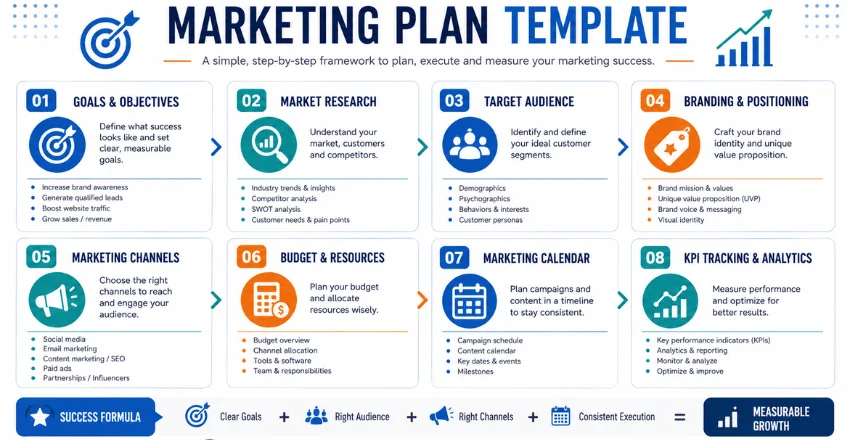
Nine rows, in this order: goal, customer, positioning, market snapshot, channels, budget, calendar, KPIs, review date. Below is the marketing plan template, and the table shows what belongs in each row, a worked example, and how long each row should take. Copy it into a blank doc and start at row one. It all fits on one page if you keep the answers short.
The short answer: a working plan needs nine parts. One measurable goal, a defined customer, a positioning line, a market snapshot, chosen channels, a budget, a dated calendar, three KPIs, and a review date. Write one honest paragraph per part. Four focused hours get you a first draft you can act on.
The nine rows, what goes in each section, and how long it takes
Every example row comes from a 12-person commercial cleaning company billing about $1.4 million a year. Swap in your own numbers. The time column is an estimate, not a stopwatch.
| Marketing Plan Template Section | What goes in it | Worked example | Time |
|---|---|---|---|
| 1. Goal | One number and one date. Revenue, contracts, or bookings, not “grow awareness.” | “Add 40 recurring accounts by December 31, worth $480,000 a year.” | 15 min |
| 2. Customer | Who buys, what triggers the purchase, and what they compare you against. | “Facilities managers at 50,000 sq ft office buildings whose vendor just quit.” | 30 min |
| 3. Positioning | One sentence: who it is for, what you do, and why you’re over the obvious alternative. | “Night cleaning for multi-tenant offices, with a photographed checklist after every visit.” | 20 min |
| 4. Market snapshot | Three competitors, their price, their pitch, and one gap you can take. | “All three sell on price. None show proof of work. We publish ours.” | 45 min |
| 5. Channels | Two or three channels, each with the reason it reaches row two. | “Local search, LinkedIn outreach, and one referral deal with an HVAC firm.” | 30 min |
| 6. Budget | A dollar figure per channel per month, plus who signs it off. | “$8,000 a month: $3,600 search ads, $2,400 case studies, $2,000 outreach.” | 30 min |
| 7. Calendar | What ships, which week, and one named owner per line. | “Week 3: eight case study pages live. Owner: Priya.” | 45 min |
| 8. KPIs | Three numbers, each with a current value and a target. | “Cost per qualified lead: $180 now, $120 by Q3.” | 20 min |
| 9. Review date | The date you reopen this and the rule that kills a channel. | “First Monday monthly. Drop any channel over $250 per lead by Q2.” | 10 min |
Key takeaways
- Nine rows, one page, four hours. That is the whole exercise.
- Every row needs a number, a name, or a date. Rows without one are decoration.
- Pick channels first and set the budget second, never the reverse.
- Three KPIs beat twelve, because three is what anyone actually checks.
- Put the review date in the document, or nobody will reopen it.
The customer and positioning rows do the heavy lifting

Most marketing plan templates die in row two. “Small business owners aged 30 to 55” is a demographic, not a buying trigger, and it tells a writer nothing about what to say or where to show up. Name the moment instead: the vendor who just walked, the inspection that just failed, or the lease that renews in March.
Row three is the sentence a salesperson repeats without checking their notes. It states who the offer serves, what it does, and why a buyer picks you over the obvious alternative. If it reads like every competitor’s homepage, the problem sits upstream in your work building a strong brand identity, not in your ad copy.
How to fill in the marketing plan template this afternoon
- Block four hours, close your email, and open one blank document.
- Write row one until it holds a number and a deadline.
- Answer row two from three real customer conversations, not from a persona worksheet.
- Draft rows three through five in one pass, then reread row one and cut anything that does not serve it.
- Price the channels you picked, then total them. That total is row six.
- Give every calendar line an owner, and do so one week before you close the file.
Steps two and three take the longest, and they should. Everything after that is arithmetic once you know who you are selling to.
Channels, tactics, and the money behind them
Two or three channels, chosen because row two already lives there. That is the rule. Eight channels for a two-person team is a wish list, and it usually means nobody wanted to say no. Row six goes vague unless you anchor it to a percentage first. The Small Business Administration’s widely quoted guidance is 7-8 percent of gross revenue for companies with less than $5 million in revenue. Published benchmarks put most sectors in this range:
| Business type | Typical marketing spend, share of revenue |
|---|---|
| B2B product companies | About 6 percent. |
| Small businesses under $5 million revenue | 7 to 8 percent. |
| B2B services firms | About 9 percent. |
| B2C product companies | 15 percent or more. |
| Early-stage B2B software | 20 to 30 percent. |
Seven percent of $1.4 million is roughly $98,000 a year, or about $8,000 a month. Split that across the two channels you actually picked, and every tactic inside them inherits a real ceiling. For filling those channels, the tactics that lift demand generation campaigns are a sensible shortlist to work from.
KPIs: pick three numbers and check them monthly
Row eight fails predictably. Someone lists twelve metrics, nobody checks any of them, and the quarterly review becomes a screenshot of a dashboard. Pick three, and give each a current value and a target.
A good set pairs one volume number, one efficiency number, and one money number:
- Qualified leads per month: 22 now, 35 by Q3.
- Cost per qualified lead: $180 now, $120 by Q3.
- Revenue sourced by marketing: $210,000 last year, $480,000 this year.
Some channels resist clean attribution, and social partnerships are the worst offenders. If yours includes one, read up on measuring influencer campaign results before you promise a number you cannot trace back to a sale.
Where marketing plans fall apart
- A goal with no number, so nobody can tell in December whether it worked.
- Channels with no named owner, which means they belong to whoever has the least on.
- Budget fixed before the channels, so the plan bends to the money instead of the customer.
- A calendar written in months rather than weeks. It slips reliably.
- No stop rule, so a channel costing $400 a lead runs until someone gets angry.
Four of those five failure modes disappear when you add one word to a row: a name, a date, or a dollar figure.
The one-page version for a single afternoon

Short on hours? Keep rows one, two, three, five, and eight, and reduce the rest to bullets. That minimum version still tells a new hire who you sell to, what you say, where you say it, and what counts as working. Fill the other four rows next month, once the first campaign has produced numbers worth planning around.
Start with row one today
Open a document, write the goal row, and give yourself 15 minutes to do it. If you cannot put a number and a date in that row, that is the finding, and everything under it will be guesswork anyway.
Frequently asked questions
Yes, if you fill it honestly. A blank format cannot decide who you sell to. Those nine rows include every decision a 12-person company needs to make, and more structure tends to slow the work down.
Strategy is the choice of this customer, this position, and these channels, held for two or three years. A plan is the schedule: what ships next quarter, who owns it, and what it costs. Rows two and three carry your strategy. Rows five through nine carry the schedule.
One to three pages suits most companies. Ten to thirty pages makes sense only when a lender or a board reads it line by line. Length follows the reader, not the ambition.
Product and price sit inside row three, since both are positioning calls. Place is in row five. Promotion is rows five and seven together. That mix serves as a checklist for those rows, not as a tenth row in its own right.
Review the KPI row monthly and adjust tactics as needed. Reopen rows one through three each quarter, and rewrite them only if something real moved, such as a segment you lost or a competitor who repriced.