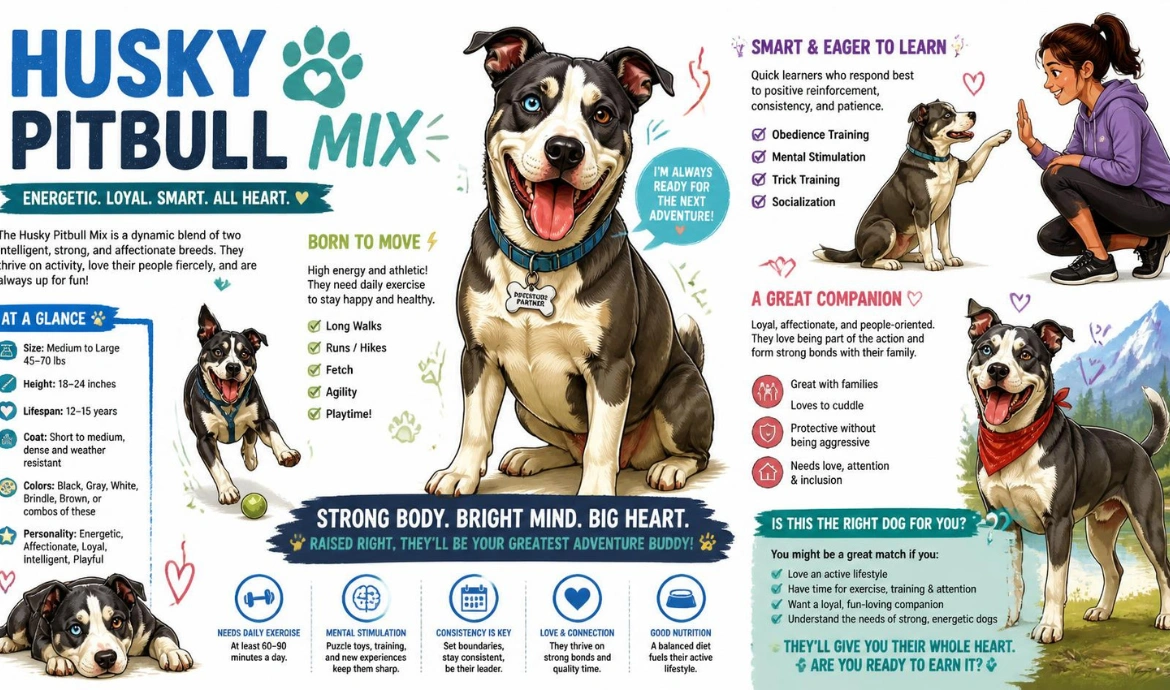
A husky-pitbull mix can be hard to overlook. Often called a Pitsky, this mixed-breed dog may combine the athletic build and people-focused nature associated with pit-bull-type dogs with the stamina, expressive personality, and striking appearance of a Siberian Husky. The result can be an affectionate and adventurous companion, but prospective owners should expect plenty of exercise, training, grooming, and day-to-day involvement.
Because the Pitsky is a mix rather than a standardized breed, there is no single appearance or personality that every dog will inherit. One puppy may develop a short coat, broad head, and muscular frame, while another may have upright ears, a thicker double coat, and the blue or differently colored eyes often associated with Huskies. Understanding both sides of the mix is therefore more useful than relying on a single Pitsky description.
Quick answer: A Husky-Pitbull mix, often called a Pitsky, is an athletic mixed-breed dog that combines Siberian Husky and pit-bull-type ancestry. Most are medium to large, energetic, people-oriented, and highly trainable with consistency, but their coat, size, prey drive, shedding, and sociability can vary widely from one dog to another.
Pitsky Quick Facts
| Trait | Typical Pitsky Expectation |
| Common name | Pitsky |
| Parentage | Siberian Husky × pit bull-type dog |
| Adult height | Often roughly 17–25 inches |
| Adult weight | Commonly around 30–70+ pounds |
| Lifespan | Often around 12–15 years |
| Coat | Short and smooth to dense and double-coated |
| Shedding | Moderate to heavy, depending on coat |
| Energy level | High |
| Temperament | Often affectionate, playful, intelligent, and energetic |
| Training | Needs consistency, socialization, and reward-based methods |
| Family fit | Often best for active, involved households |
| Apartment living | Possible with sufficient exercise and management |
| Grooming | Usually weekly or more often during heavy shedding |
| Major considerations | Exercise, prey drive, roaming, strength, shedding, training |
These ranges should be treated as planning estimates rather than a breed standard. The American Kennel Club lists Siberian Huskies at 35–60 pounds and 20–23.5 inches tall. The United Kennel Club describes American Pit Bull Terriers as athletic dogs with desirable adult weights of roughly 30–60 pounds and heights of about 17–21 inches, depending on sex. Published Pitsky profiles consequently show a fairly wide range, which is exactly what owners should expect from a non-standardized mix.
What Is a Pitsky?
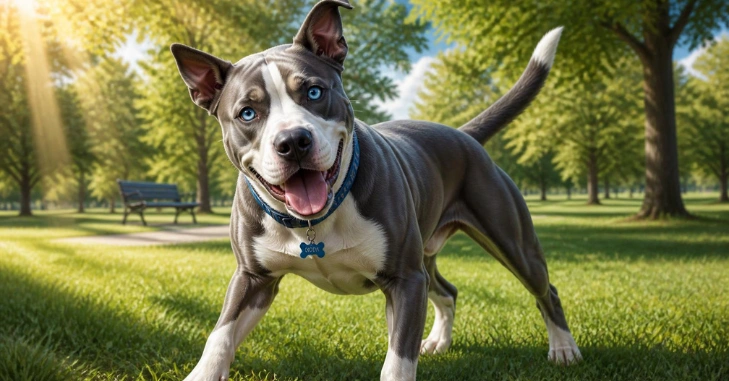
A Pitsky is generally a cross between a Siberian Husky and an American Pit Bull Terrier or another dog commonly described as a pit-bull type. The word “pitbull” can be used differently by breeders, shelters, owners, and registries, so it is worth finding out the actual parentage whenever possible. An American Pit Bull Terrier, American Staffordshire Terrier, or another bully-type parent can influence the puppy’s eventual size, build, coat, and behavior in different ways.
The mix is not an AKC-recognized breed and does not have an official Pitsky breed standard. That lack of standardization means two dogs advertised under the same name can look and behave surprisingly differently, even when both genuinely have Husky and pit-bull-type ancestry. DNA testing can provide additional ancestry information for adopted dogs, but the individual dog’s observed health, behavior, and needs remain more important than a label.
What Does a Husky-Pitbull Mix Look Like?
A Husky-Pitbull mix usually has an athletic body, but almost every visible feature can fall somewhere between the two parent types. Some Pitskies develop the broader chest and shorter coat associated with a pit-bull-type parent, while others have a leaner outline, thicker coat, erect ears, and facial markings reminiscent of a Husky. Common colors can include black, white, gray, brown, tan, red, brindle, or combinations of several colors.
Eye color is another source of variation. Siberian Huskies can have brown eyes, blue eyes, or one of each, so some Pitskies inherit similarly noticeable eyes. However, a Husky parent does not guarantee that a puppy will have blue eyes, upright ears, a curled-looking tail, or a classic Husky mask.
How Big Does a Pitsky Get?
Many adult Pitskies fall somewhere around 30 to 70 pounds, although larger or smaller dogs are possible. Heights in mixed-breed profiles commonly extend from the upper teens into the mid-20-inch range at the shoulder. The actual size of the parents is a better clue for a growing puppy than an online average because this cross has no fixed breed standard.
If you are bringing home a puppy, ask for the parents’ adult weights and health information whenever those details are available. Growth should be monitored for healthy body condition rather than pushed toward a particular number on the scale. Your veterinarian can help you determine whether a growing or adult dog is maintaining an appropriate weight for its frame.
Pitsky Temperament and Personality
A well-socialized Pitsky is often playful, affectionate, energetic, and strongly interested in being part of household activities. Siberian Huskies are known for being friendly, social, active, and sometimes independent, while the UKC describes the American Pit Bull Terrier as confident, enthusiastic, intelligent, and eager to please. A Pitsky may inherit any combination of those tendencies rather than an exact 50/50 personality.
Owners should also prepare for traits that require active management. Huskies can have a strong desire to run and chase, while pit-bull-type dogs can be physically powerful and may require careful socialization around other dogs depending on the individual. Temperament also depends on genetics, early experiences, health, training, environment, and what behaviors are repeatedly practiced or rewarded.
Are Pitskies Aggressive?
It is not accurate to assume that a Pitsky will be aggressive simply because of its ancestry, and it is equally unwise to promise that any dog will always be safe in every situation. Individual behavior is influenced by much more than a breed label, including socialization, fear, previous experiences, pain, training, and day-to-day management. Owners should evaluate the dog in front of them and seek professional help if they notice persistent fear, guarding, reactivity, or aggressive behavior.
Early prevention matters, especially with a strong, athletic dog. Calm leash walking, reliable handling, impulse control, appropriate introductions, and positive experiences around people and animals can make everyday life far easier as the dog matures. If serious behavior problems appear, a veterinarian or qualified reward-based behavior professional is more appropriate than relying on generalized breed advice.
Are Pitskies Good Family Dogs?
A Pitsky can be a loving family companion in a household that has enough time for activity, training, and supervision. Both sides of the mix can be people-oriented, but Pitskies may also be excitable, strong, and energetic enough to accidentally knock over a small child during enthusiastic play. Adults should supervise interactions, teach children to respect a dog’s food and resting areas, and give the dog a quiet place where it will not be disturbed.
The same individual approach applies to other pets. Some Pitskies live successfully with dogs or cats, while others may inherit a stronger prey drive or may prefer more carefully managed relationships with other animals. If you are still comparing family-oriented mixed dogs, Ventweek’s guide to why Goldendoodles make wonderful family companions offers another useful perspective on choosing a dog for household life.
How Much Exercise Does a Pitsky Need?
Expect exercise to be one of the biggest daily commitments of owning this mix. Siberian Huskies were developed for endurance and the AKC describes them as active working dogs that need substantial physical and mental activity, while pit-bull-type dogs are also athletic and capable of demanding sports. For many adult Pitskies, a quick trip around the block will not provide enough stimulation by itself.
A useful routine combines purposeful walks, play, sniffing, training exercises, and mentally engaging activities rather than relying only on repetitive running. Hiking, appropriately managed jogging, scent games, food puzzles, obedience exercises, and dog sports can all help channel energy, depending on the dog’s age and health. Growing puppies should not be pushed into repetitive high-impact or long-distance exercise before their bodies have matured, so discuss demanding activities with your veterinarian.
A yard can make life easier, but it does not replace interaction. Huskies are well known for running, digging, and escape behavior, and the UKC also emphasizes secure fencing for American Pit Bull Terriers because of their athletic ability. A Pitsky should therefore have secure containment and should not be trusted off-leash simply because the dog normally stays close to home.
Training a Pitsky
Training should begin as soon as your dog arrives and should focus on behaviors that make a powerful, energetic dog easier to live with. Useful priorities include responding to a name, walking without pulling, coming when called, leaving objects alone, dropping items, waiting calmly at doors, settling on a mat, and accepting routine handling. Short, engaging sessions usually fit this mix better than long drills that become repetitive.
Reward-based training is the evidence-supported approach. The American Veterinary Society of Animal Behavior recommends reward-based methods for dog training and advises against aversive methods that depend on pain, fear, or physical discomfort. Food, toys, access to enjoyable activities, and praise can all reinforce behaviors you want the dog to repeat.
Socialization should also start early and be thoughtful rather than overwhelming. AVSAB identifies the first three months as a particularly important socialization period and recommends safe exposure to people, animals, surfaces, environments, sounds, and other experiences without forcing frightened puppies into situations they cannot handle. Ventweek’s dog training tricks to remember can provide additional general training ideas once you have established a reward-based foundation.
Grooming and Shedding
The amount of grooming a Pitsky needs depends heavily on the coat it inherits. A short-coated dog may be relatively simple to maintain with regular brushing and occasional bathing, while a dog with a Husky-like double coat can shed heavily and require more frequent brushing during seasonal coat changes. Siberian Huskies naturally shed their undercoat and the AKC recommends regular brushing to keep the coat and skin in good condition.
Do not assume shaving a thick-coated Pitsky will make summer easier. The AKC notes that a healthy double coat contributes to temperature regulation and advises against shaving double-coated breeds merely to reduce shedding or keep them cooler. Routine brushing, removing loose undercoat, providing shade and water, and managing exercise around the weather are better approaches.
Basic care should also include nail trims, dental care, and regular ear checks. Dogs that spend a lot of time hiking or running outdoors should have their paws checked for cuts, irritation, foxtails, or other debris after outings. A veterinarian or professional groomer can help owners who are unsure how to handle nails, ears, coat tools, or dental care safely.
Feeding and Healthy Weight
There is no universal number of cups of food that every Pitsky should eat. Calorie needs change with age, body size, activity, reproductive status, health, and the calorie density of the food itself, so two Pitskies of similar weight may still require different portions. Choose a nutritionally complete food appropriate for the dog’s life stage and use the manufacturer’s feeding guide as a starting point while monitoring body condition.
Active dogs still need weight control rather than unlimited calories. Extra weight increases physical stress on the body and can make demanding exercise more difficult, while an underfed athletic dog may struggle to maintain muscle and energy. Your veterinarian can adjust portions if your Pitsky is growing rapidly, unusually active, gaining unwanted weight, or dealing with a medical condition.
Common Health Concerns to Discuss With a Veterinarian
Mixed ancestry does not make a dog automatically free of inherited health problems. Siberian Husky health recommendations include hip and ophthalmologist evaluations, while recommended testing for the related American Staffordshire Terrier includes hip, cardiac, thyroid, and NCL4A testing. These recommendations do not prove that an individual Pitsky will develop any particular disease, but they show why responsible health screening of parent dogs matters.
Potential owners should ask breeders for verifiable health-testing records rather than accepting vague claims that the parents were simply “vet checked” at some point in the past. Rescue dogs may not come with parental health records, making routine veterinary exams and attention to mobility, eyes, skin, weight, heart health, and behavior especially useful. Any sudden change in movement, appetite, energy, vision, breathing, or behavior deserves veterinary attention rather than online diagnosis.
A reasonable planning estimate for Pitsky’s lifespan is around 12 to 15 years, although no fixed lifespan exists for the mix. Siberian Huskies have an AKC-listed life expectancy of 12–14 years, while current Pitsky profiles commonly place the mixed dog’s expected range around the low-to-mid teens. Good preventive care, healthy weight, appropriate exercise, genetics, and individual medical history can all influence longevity.
Caring for a Pitsky in Hot U.S. Weather
Owners in warmer parts of the United States should plan exercise around temperature and humidity, particularly if their Pitsky inherits a dense coat. Dogs rely heavily on panting to cool themselves and can overheat during strenuous activity, so early-morning or evening exercise, constant access to fresh water, and cool indoor rest areas are important. Excessive panting, heavy drooling, weakness, vomiting, loss of coordination, or collapse can indicate dangerous overheating and require prompt veterinary attention.
Hot pavement can also injure paws even when a dog appears eager to continue walking. Reduce outdoor intensity during extreme heat and never leave a dog unattended in a parked vehicle, even for a short stop. A high-energy Pitsky may still want to play in uncomfortable weather, so the owner has to set the safer limit.
Can a Pitsky Live in an Apartment?
Apartment living is possible for some Pitskies, but square footage is only one part of the decision. A well-exercised dog with regular outdoor access, training, and enrichment may settle more successfully than a bored dog living in a large house with little interaction. Owners also need to consider possible Husky-like vocalization, excitement in shared hallways, leash manners, and opportunities for safe daily exercise.
Before bringing home a Pitsky, renters should check the rules that apply to their specific property. Landlord policies, homeowners associations, insurance requirements, and local dog regulations can differ across the United States, especially for dogs identified as pit-bull type. Confirming those details before adoption is far easier than discovering a housing conflict after the dog is already part of the family.
Pros and Cons of Owning a Pitsky
Potential Advantages
- Affectionate and people-oriented personality.
- Athletic companion for active owners.
- Intelligent and capable of learning many skills.
- Striking variety of coats, markings, and eye colors.
- Can enjoy hiking, training, play, and dog sports.
- Often happiest when included in family activities.
Potential Challenges
- High daily exercise and enrichment needs.
- Possible strong prey or chase drive.
- May inherit Husky-like roaming or escape behavior.
- Can be physically strong on leash.
- Coat may shed heavily.
- Early training and socialization are important.
- Some individuals need careful management around other animals.
- Housing or insurance restrictions may need to be checked.
Is a Pitsky Right for You?
The ideal Pitsky owner is prepared to do more than admire the dog’s appearance. This mix usually makes the most sense for someone who enjoys an active lifestyle, has time for daily training and enrichment, can provide secure containment, and is comfortable managing a strong dog. Owners who want a very low-energy, low-shedding, or highly independent pet may find the combination more demanding than expected.
A first-time dog owner can still succeed with a Pitsky if they are willing to learn, build good routines, and seek qualified help when necessary. Conversely, previous dog ownership does not compensate for inadequate exercise, inconsistent boundaries, or unsafe management. Lifestyle fit matters more than whether a person can technically handle the dog’s size.
Final Thoughts
A husky-pitbull mix can be affectionate, athletic, entertaining, and deeply involved with its family, but the Pitsky is rarely a low-effort companion. Prospective owners should be prepared for significant exercise, patient training, secure management, routine grooming, veterinary care, and plenty of mental stimulation. Choosing the individual dog for your actual lifestyle is far more important than choosing one because of blue eyes, a particular coat, or assumptions about either parent breed.
When adopting an adult Pitsky, pay attention to the dog’s demonstrated behavior and health instead of expecting a stereotype. When buying a puppy, look for responsible breeding practices, meaningful parent health testing, thoughtful early socialization, and honest answers about temperament and living conditions. For more pet ownership and care content, you can also explore Ventweek’s Pets section.
Frequently Asked Questions
What is a Husky-Pitbull mix called?
A Husky and pit-bull-type cross is commonly called a “pitsky.” The name is informal rather than an official breed designation, so dogs called “pitskies” can have different pit-bull-type ancestry and different physical traits. Asking about the actual parents gives you more useful information than relying on the mixed-breed name alone.
How big does a Husky-Pitbull mix get?
Many Pitskies mature somewhere around 30 to 70 pounds, although dogs outside that range are possible. Adult height is often in the upper teens to mid-20s at the shoulder, depending largely on the parents. Because there is no official breed standard, parent size and the individual dog’s growth pattern are more meaningful than a single internet average.
How long do Pitskies live?
A commonly reported planning range is approximately 12 to 15 years. That estimate overlaps with the Siberian Husky’s AKC-listed 12–14-year life expectancy, but a mixed dog’s actual lifespan cannot be predicted from ancestry alone. Genetics, preventive care, nutrition, weight, exercise, accidents, and disease all influence longevity.
Do Pitskies shed a lot?
Some do, especially if they inherit a dense Husky-style double coat. Others have shorter coats and may shed more moderately, so grooming requirements can vary considerably even within the same mix. Regular brushing is useful in either case and should become more frequent when a thick-coated dog is shedding heavily.
Are Pitskies easy to train?
Pitskies can be intelligent and capable learners, but intelligence does not always mean automatic obedience. A dog that inherits Husky-like independence may need especially engaging, consistent training, while strength and enthusiasm make good manners important from an early age. Reward-based training with clear routines gives owners the best foundation.
Can a Pitsky live with cats?
Some Pitskies live successfully with cats, while others may show a strong chase or prey drive. Early, controlled introductions and physical management such as gates, leashes, and separate safe areas can help, but no breed mix guarantees compatibility. Adult dogs with unknown histories should be evaluated individually rather than assumed to be cat-safe.
Does a Pitsky need a fenced yard?
A secure fenced area is extremely useful but is not a substitute for walks, training, and interaction. The Husky side can contribute a powerful desire to roam, while both parent types are athletic enough to challenge weak fencing. Gates, fence height, digging points, and opportunities for climbing should therefore be considered carefully.