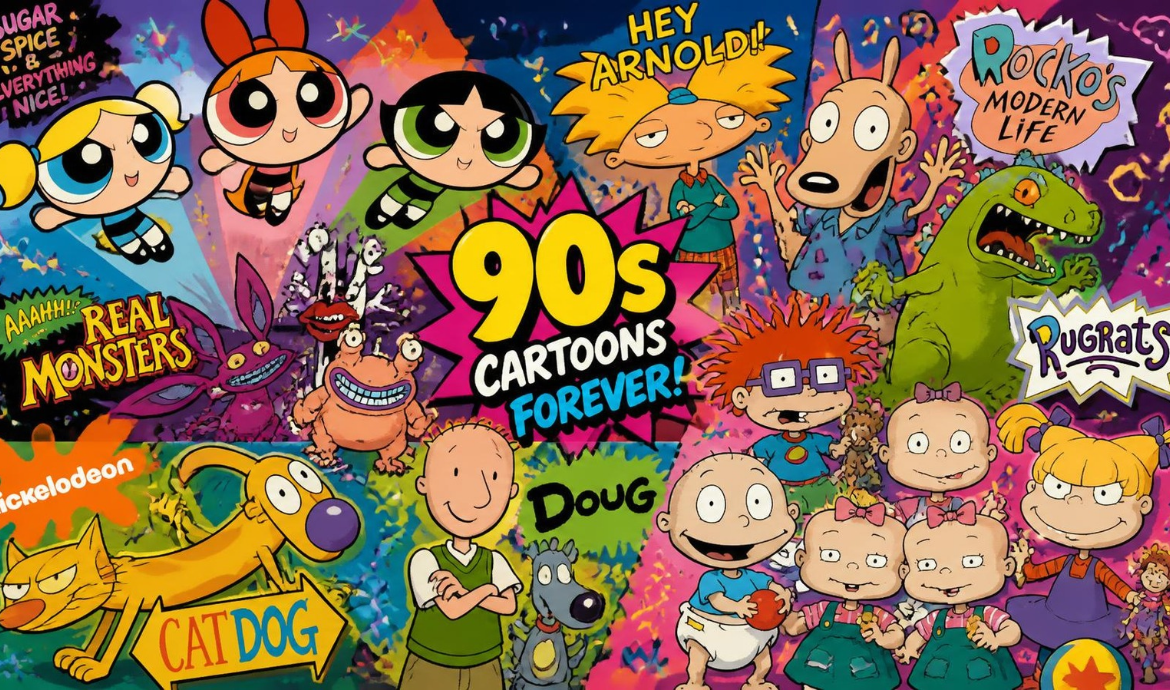
American television animation changed dramatically during the 1990s. 90s cartoons gave kids superheroes, strange families, talking babies, schoolyard adventures, and fearless comedy. Many of these shows remain instantly recognizable decades later.
Nickelodeon launched its original Nicktoons era with Doug, Rugrats, and The Ren & Stimpy Show in 1991. Cartoon Network followed with its national launch in 1992 and later developed signature original programming. Together, those networks helped create a decade packed with distinct animated voices.
Direct answer: The decade’s most memorable animated shows include Rugrats, Batman: The Animated Series, Animaniacs, Dexter’s Laboratory, Hey Arnold!, and The Powerpuff Girls. They mixed distinctive art, memorable characters, sharp comedy, and surprisingly mature storytelling. That combination helped many series remain popular with adults who first watched them as children.
Quick Guide to 15 Essential Animated Shows
| Show | U.S. debut | Best remembered for |
|---|---|---|
| Rugrats | 1991 | Childhood adventures from a baby’s viewpoint |
| Doug | 1991 | Everyday school and growing-up problems |
| Batman: The Animated Series | 1992 | Dark superhero storytelling |
| X-Men: The Animated Series | 1992 | Serialized Marvel superhero drama |
| Animaniacs | 1993 | Fast comedy and pop-culture jokes |
| Rocko’s Modern Life | 1993 | Strange humor with adult undertones |
| Gargoyles | 1994 | Fantasy, mythology, and serialized drama |
| Dexter’s Laboratory | 1996 | Science comedy and visual gags |
| Hey Arnold! | 1996 | Urban childhood stories with heart |
| South Park | 1997 | Adult satire and topical comedy |
| Recess | 1997 | Playground society and school friendships |
| The Powerpuff Girls | 1998 | Superhero action mixed with comedy |
| Pokémon | 1998 U.S. debut | Adventure, collecting, and friendship |
| SpongeBob SquarePants | 1999 | Surreal underwater comedy |
| Ed, Edd n Eddy | 1999 | Neighborhood schemes and slapstick |
Key Takeaways
- Nickelodeon’s original animation push helped redefine children’s cable television during the decade.
- Cartoon Network opened nationally in 1992 and developed major original series later in the decade.
- Superhero animation became more sophisticated through shows including Batman and X-Men.
- Several late-decade programs continued far beyond 1999 and reached new generations.
Why 90s Cartoons Felt Different
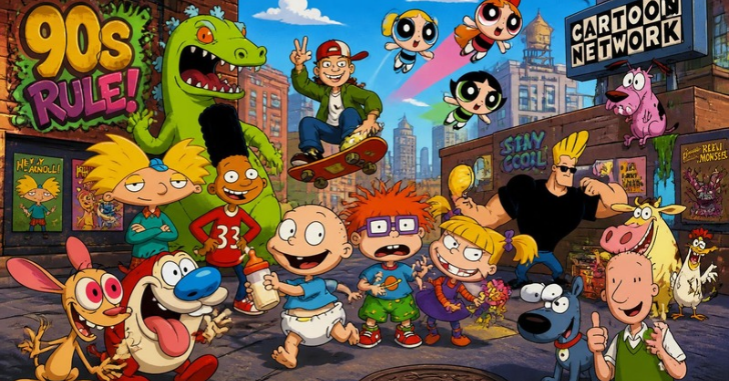
The decade gave creators room to experiment with visual styles, humor, and storytelling. Children could move from superheroes to bizarre comedy without leaving afternoon television. Adult viewers sometimes found jokes that younger audiences completely missed.
Distribution also changed during this period, helping 90s cartoons reach wider audiences. Cable channels built stronger identities around original programming instead of relying only on older syndicated animation. Cartoon Network officially launched on October 1, 1992, initially reaching about two million U.S. homes.
Nickelodeon made an equally important move one year earlier. Its first three original Nicktoons premiered together on August 11, 1991. Nickelodeon Animation credits Rugrats with helping usher in that original-animation era.
1. Rugrats
Rugrats made ordinary childhood spaces feel enormous. Tommy, Chuckie, Angelica, Phil, and Lil turned homes and backyards into unpredictable adventure zones. The storytelling worked because viewers saw familiar situations through a toddler’s imagination.
The series premiered on August 11, 1991, according to Nickelodeon Animation. Its unusual viewpoint separated it from many earlier children’s programs. Family relationships also gave episodes more emotional weight than simple slapstick offered.
2. Batman: The Animated Series
Batman: The Animated Series showed that children’s superhero television could carry serious atmosphere. Gotham looked shadowy, dangerous, and influenced by older crime films. The show still balanced that darkness with accessible character-driven stories.
Batman’s villains often received emotional motives instead of simple evil plans. That choice made figures like Mr. Freeze especially memorable. The series helped establish a higher dramatic standard for television superhero animation.
3. Animaniacs
Animaniacs moved at an extraordinary pace. Yakko, Wakko, and Dot jumped between songs, historical jokes, movie references, and absurd comedy. Younger viewers could enjoy the chaos without catching every reference.
The program also introduced recurring characters with their own distinctive formats. Pinky and the Brain became especially successful outside the main Warner siblings segments. That variety kept individual episodes from feeling predictable.
4. X-Men: The Animated Series
X-Men: The Animated Series delivered superhero action without ignoring heavier themes. Its heroes faced prejudice, fear, loyalty conflicts, and disagreements within their own team. Those ideas gave the battles greater emotional importance.
The show also trusted younger audiences with continuing storylines. Events could carry consequences across several episodes instead of disappearing after each adventure. That approach helped serialized superhero television gain a larger audience.
5. Doug
Doug found drama in problems that looked small to adults. School embarrassment, friendships, crushes, and social anxiety could feel enormous to its young protagonist. Doug’s imagination turned those ordinary concerns into colorful fantasy sequences.
The series was among Nickelodeon’s three original Nicktoons launched in 1991. Its quieter personality contrasted strongly with louder programs around it. That grounded approach became part of its lasting appeal.
6. Rocko’s Modern Life
Rocko’s Modern Life looked like a colorful children’s comedy but often felt stranger underneath. Rocko faced annoying neighbors, jobs, bills, social problems, and bizarre modern inconveniences. Adults could recognize frustrations that younger viewers saw as nonsense.
The animation pushed expressions and physical comedy into exaggerated territory. Its world rarely behaved normally, even during ordinary errands. That odd combination created humor that aged differently from simpler childhood programming.
7. Gargoyles
Gargoyles brought mythology and dramatic continuity into weekday animation. Its stone warriors awakened in modern Manhattan after centuries trapped by a magical curse. Their old values constantly collided with a new world.
The series took its mythology seriously without losing its adventure focus. Characters changed, alliances shifted, and earlier events could matter much later. That structure rewarded viewers who followed episodes consistently.
8. Dexter’s Laboratory
Dexter had intelligence, technology, and a secret laboratory beneath his home. He still struggled against one unstoppable force: his sister Dee Dee. Their conflict turned elaborate science-fiction ideas into simple sibling comedy.
The program grew from Cartoon Network’s What a Cartoon! development model. Full episodes began arriving in 1996 during the network’s expanding original-programming period. Its sharp visual timing influenced later television animation.
9. Hey Arnold!
Hey Arnold! treated its city neighborhood almost like another character. Arnold encountered classmates, boarders, shopkeepers, teachers, and neighbors carrying their own problems. Stories could move between comedy and surprisingly serious emotions.
The show rarely treated children as emotionally simple people. Characters could be selfish, lonely, frightened, jealous, or generous within the same series. That emotional range helps many episodes remain relatable to adult viewers.
10. The Powerpuff Girls
Blossom, Bubbles, and Buttercup combined kindergarten life with superhero battles. Their cute designs contrasted sharply with fast fights and destructive villains. That visual contradiction gave the series an identity viewers recognized immediately.
The show arrived during Cartoon Network’s late-1990s original-programming expansion. Its villains were often as memorable as the heroes themselves. Mojo Jojo, Him, and others helped create an unusually colorful superhero universe.
11. Recess
Recess imagined an elementary-school playground as a miniature society. Kids created rules, social groups, leaders, traditions, and unwritten boundaries. The setup made everyday school politics surprisingly entertaining.
T.J. and his friends represented different personalities without losing their group chemistry. Episodes often centered on fairness, friendship, conformity, or standing up to authority. Those themes gave the comedy a recognizable childhood foundation.
12. Pokémon
American children met Ash, Pikachu, and the wider Pokémon world during the franchise’s explosive U.S. expansion. The series mixed travel, competition, friendship, and collecting within an ongoing adventure. It also connected television directly with games, cards, toys, and playground culture.
Few animated properties became such broad childhood experiences so quickly. Kids could watch an episode and continue the same interest elsewhere. That cross-media presence made Pokémon larger than a single television program.
13. South Park
South Park belonged to adult animation rather than children’s programming. Its intentionally simple visual style supported aggressive satire and topical comedy. The series premiered on Comedy Central in 1997.
Its success also made creators Trey Parker and Matt Stone major figures in American comedy. Readers interested in that history can explore Ventweek’s feature on Trey Parker and his entertainment career. The show’s longevity demonstrates how strongly late-1990s adult animation expanded.
14. SpongeBob SquarePants
SpongeBob SquarePants arrived at the decade’s end and quickly developed a distinctive comic voice. SpongeBob, Patrick, Squidward, and Mr. Krabs turned Bikini Bottom into a flexible comedy setting. Episodes could be sweet, ridiculous, irritating, or surreal.
Paramount records the series’ launch in 1999. Its characters later became part of a much larger global franchise. Few late-decade debuts had such a long cultural afterlife.
15. Ed, Edd n Eddy
Ed, Edd n Eddy captured the strange economics of neighborhood childhood. The three Eds constantly invented schemes intended to earn enough money for jawbreakers. Those plans usually collapsed through greed, bad luck, or terrible judgment.
The cul-de-sac setting kept the show’s world small and recognizable. Strong poses and exaggerated movement gave its slapstick a distinctive rhythm. It became another important piece of Cartoon Network’s original identity.
What Made the Decade So Memorable?
No single network created the era alone. Nickelodeon pursued creator-driven Nicktoons while Cartoon Network built its own original identity. Warner Bros., Disney, Fox, and other outlets added superhero, comedy, and adventure programming.
The decade also supported unusually different tones. A viewer could move from Hey Arnold! to Batman without expecting the same emotional experience. Adult animation expanded too, creating space for programs such as South Park.
That variety still shapes current entertainment. Modern superhero and adult animation continue many ideas established or popularized during this period. Ventweek’s Viltrumite weakness explainer on the Invincible universe shows how animated superhero storytelling remains a major entertainment category.
The Simpsons Connection
The Simpsons technically premiered before the decade began, so it isn’t included in this debut-focused list. Still, its 1990s run strongly influenced television comedy and adult animation. Ignoring that influence would leave an obvious gap in the decade’s story.
Its supporting characters became cultural fixtures alongside the Simpson family. Ventweek’s detailed Mr. Burns guide explores one of the program’s longest-running antagonists. The series helped prove that prime-time animation could sustain an adult audience.
Revisit More Television and Animation Stories
The 1990s produced far more memorable animation than any 15-show list can contain. Shows like Johnny Bravo, Daria, Tiny Toon Adventures, and The Wild Thornberrys deserve rediscovery too. Personal favorites often depend on which channels reached your home.
For more television, animation, celebrity, and pop-culture features, browse Ventweek’s Entertainment section. Rewatch an old favorite afterward and see which jokes land differently now. The strongest 90s cartoons can still surprise viewers who remember every theme song.
Frequently Asked Questions
What were the most popular 90s cartoons?
Popularity varied by year, network, and audience. Rugrats, Batman, Pokémon, The Powerpuff Girls, and SpongeBob became especially recognizable American franchises. Other viewers may strongly associate the decade with Disney, Fox Kids, or Warner Bros. programs.
Which Nickelodeon animated shows started the Nicktoons era?
Doug, Rugrats, and The Ren & Stimpy Show launched together on August 11, 1991. Contemporary reporting described the three programs as a major original-animation push for Nickelodeon. That launch helped establish the network’s animated identity for years afterward.
Which Cartoon Network shows began during the 1990s?
Notable originals included Dexter’s Laboratory, Johnny Bravo, Cow and Chicken, The Powerpuff Girls, and Ed, Edd n Eddy. Cartoon Network itself launched nationally in October 1992. Its original programming became increasingly important as the decade progressed.
Why do people still watch 90s cartoons?
Nostalgia explains part of their appeal, but it isn’t the entire reason. Strong character designs, memorable voices, and distinctive storytelling still make many episodes entertaining. Adults also notice themes and jokes they missed during childhood.
—–