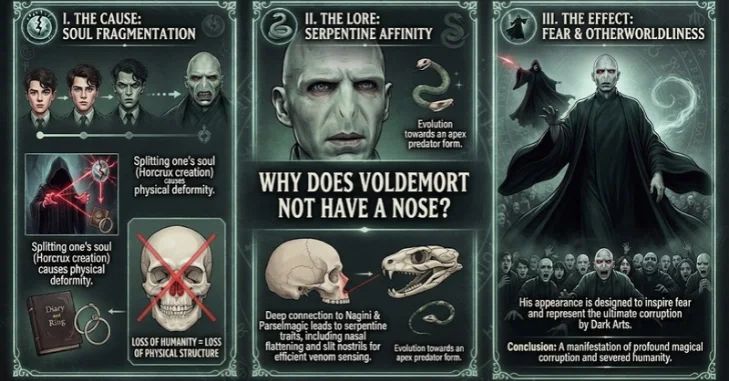
If you have watched the Harry Potter movies, the Dark Lord’s face is impossible to forget. His pale skin and red eyes are disturbing, but his flattened nose attracts the most questions. So, why does Voldemort not have a nose, and did something specific happen to it?
The simplest explanation is that years of Dark Magic changed Tom Riddle’s body and made him increasingly snake-like. The books show that this transformation happened gradually rather than after one clearly identified event. The films pushed that description further by visually reducing his nose to two snake-like nostril slits.
Direct answer: Voldemort’s nose became flat and snake-like as Tom Riddle transformed through years of Dark Magic. His pursuit of immortality, creation of Horcruxes, and magical experiments coincided with increasingly inhuman features. The books describe a flat, snake-like nose, while the movies made the effect more dramatic through visual effects.
Voldemort’s Nose: Key Facts
| Question | Short answer |
| Did Tom Riddle originally have a normal nose? | Yes. His younger appearance was human and handsome. |
| Did Harry remove his nose? | No. His appearance changed long before his final battles with Harry. |
| Did one spell remove it? | No specific spell is identified as the cause. |
| Are Horcruxes involved? | They are closely connected to his transformation, but the books do not say one Horcrux directly removed his nose. |
| Why does he look like a snake? | His appearance reflects his increasing separation from ordinary humanity and his association with snakes. |
| Did the movies exaggerate his appearance? | Yes. The films visually reduced Ralph Fiennes’s nose to create the familiar snake-like face. |
Why Does Voldemort Not Have a Nose in Harry Potter?
Why Does Voldemort Not Have a Nose? No scene shows Tom Riddle casting a spell and suddenly losing his nose. Instead, the books reveal a gradual physical transformation as he pursues increasingly dangerous magic. By adulthood, his handsome human appearance has become pale, distorted, and distinctly serpentine.
Harry Potter and the Half-Blood Prince provides an important clue through Dumbledore’s memories. Harry sees an older Riddle whose features have already become waxy and distorted. Yet this version is still less snake-like than the Dark Lord Harry later encounters.
That progression matters because it shows his appearance changed before his resurrection in Goblet of Fire. The resurrection ritual did not simply turn an ordinary-looking man into the familiar villain. His physical humanity had already been deteriorating during his rise as a Dark wizard.
Dark Magic Changed Tom Riddle’s Appearance
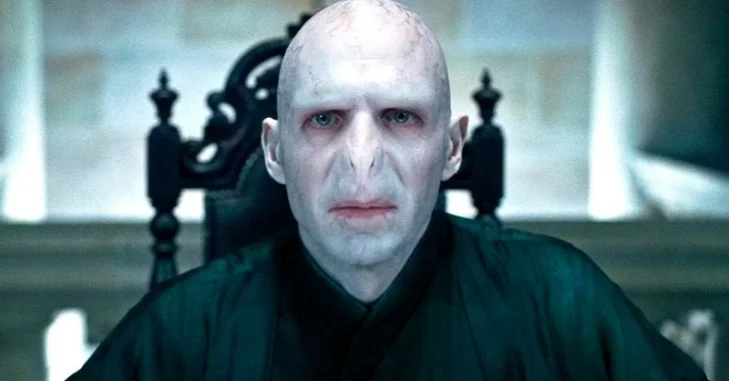
Young Tom Riddle did not look like the villain seen during Harry’s years at Hogwarts. He was described as handsome, which helped him appear charming and trustworthy when needed. His physical changes became more noticeable as he went deeper into forbidden magic.
Voldemort became an exceptionally powerful Dark wizard who pursued immortality further than most magical characters. His abilities included the Dark Arts and the creation of multiple Horcruxes. Those pursuits help explain his increasingly unnatural appearance.
Still, readers should distinguish what the books establish from what fans infer. The story connects his changing appearance with his descent into Dark Magic. It never gives a simple formula saying each Horcrux removed a particular human feature.
Did Creating Horcruxes Destroy His Nose?
Horcruxes are one of the strongest explanations for his physical transformation, but the details require some caution. Creating one involves murder and magically splitting the soul. Voldemort went further than other known practitioners by dividing his soul repeatedly.
That process clearly represents his rejection of normal human limits within the story. His outward appearance becomes less human during the same period. This makes Horcrux creation a reasonable part of the explanation without making it the confirmed sole cause.
His appearance also changed gradually rather than after one documented Horcrux creation. Dumbledore’s memories provide evidence of an intermediate stage between handsome Riddle and the later snake-like villain. That detail suggests repeated Dark Magic and soul damage contributed to a broader transformation.
What Does Voldemort’s Nose Look Like in the Books?
The books do not literally describe him as having no nose at all. In Harry Potter and the Goblet of Fire, his resurrected body has a nose that is flat and snake-like. Its nostrils appear as slits rather than normal human nostrils.
That distinction explains why readers and movie viewers sometimes describe him differently. Book readers can imagine a flattened, reptilian nose that still exists anatomically. The films make the feature look almost completely absent.
He can also use his nostrils normally in the books. He sniffs, and his slit-like nostrils widen, showing that they remain functional. The transformation therefore affects his appearance without eliminating his ability to smell.
Why Does He Look So Much Like a Snake?
The snake resemblance fits several established parts of his character. He is a descendant of Salazar Slytherin and can speak Parseltongue. He also develops an unusually important relationship with his snake, Nagini.
His adult face visually reinforces those associations through pale skin, unusual eyes, and slit-like nostrils. The result separates him sharply from the handsome young man shown in earlier memories. Physical appearance can become a major part of how audiences recognize public and fictional figures, much like Ventweek’s coverage of Ainsley Earhardt’s net worth and career.
This symbolism does not mean every snake-like feature has an individual magical explanation. The story never provides a detailed medical-style account of each physical change. Instead, the transformation develops alongside his obsession with power, immortality, and forbidden magic.
Did the Resurrection Ritual Cause His Missing Nose?
The graveyard resurrection in Harry Potter and the Goblet of Fire is another common explanation. Peter Pettigrew performs an ancient Dark Magic ritual using bone, flesh, and Harry’s blood. The ritual restores his master to a complete bodily form.
Yet the ritual cannot fully explain the snake-like appearance. Earlier descriptions and memories indicate that his features had already changed significantly. The graveyard scene gives him a new physical body, but it reflects a transformation that began much earlier.
This also challenges theories claiming the ritual alone created his strange nose. The chronology points toward a longer process connected with his magical practices. The resurrection makes the appearance especially visible rather than providing a confirmed single cause.
How the Harry Potter Movies Removed Ralph Fiennes’s Nose
Actor Ralph Fiennes obviously has a normal nose, so filmmakers needed to alter his face. Digital visual effects created the flattened, slit-like appearance audiences associate with the character. The change helped make his face more reptilian without covering it with a large prosthetic feature.
The movie version is more extreme than the wording many readers remember from the books. His nose appears almost entirely removed, leaving two slits where normal nostrils would sit. Visual design can strongly shape how audiences remember a character, much as Euphoria’s character styling uses appearance to reinforce personality and storytelling.
The effect also preserved much of Fiennes’s facial movement during his performance. Viewers could still see expressions while the altered anatomy made the character look unnatural. It became one of the most recognizable pieces of the film series’ villain design.
Was Voldemort Born Without a Nose?
No, he was not born with the snake-like face seen later in the series. As Tom Riddle, he looked human throughout childhood and his Hogwarts years. His appearance changed after he became deeply involved with Dark Magic.
That difference is especially clear when the series shows younger versions of him. The handsome student and the later Dark wizard barely resemble each other. His changing face therefore belongs to his transformation rather than his ancestry alone.
The timeline also rules out the idea that Harry caused the missing nose. His appearance had become unnatural before his return to full power. Harry’s survival affected his physical existence, but it did not begin his earlier transformation.
Does Voldemort Have a Nose or Not?
Technically, the book version still has a nose, although it barely resembles a human one. It is described as flat and snake-like, with slits serving as nostrils. That means saying he has “no nose” is mostly shorthand based on his movie appearance.
The distinction is useful because it separates the original description from the film interpretation. The books emphasize an increasingly serpentine face. The movies translate that idea into a stronger visual design by making the nose appear nearly absent.
So, the famous feature is not a mysterious injury that the story forgot to explain. It belongs to a much larger transformation affecting his entire body. His skin, eyes, face, and nose all become less recognizably human.
Why His Changing Face Matters to the Story
The physical transformation mirrors a central part of the character’s story. Tom fears death and seeks immortality regardless of the cost. His attempts to escape human mortality gradually leave him looking less human.
That contrast becomes clearer when Harry learns about his earlier life. Young Riddle could appear charming, attractive, and controlled despite his cruelty. The later villain no longer hides what decades of destructive choices have made him.
His face therefore does more than make him frightening on screen. It visually separates Tom Riddle from the identity he creates for himself. Readers interested in more personality-focused entertainment stories can also explore Ventweek’s profile of Aimee Osbourne.
The Simple Explanation
The mystery becomes easier once the books and movies are separated. There was no confirmed accident, duel, or single spell that removed the Dark Lord’s nose. His body changed gradually as his involvement with destructive magic deepened.
The books present that change as part of his journey from handsome Tom Riddle to an almost inhuman figure. Horcruxes fit into that transformation, but they should not be treated as a precisely documented cause. The films then amplified the snake-like description through digital effects.
For readers, that is the key distinction to remember. In the book, Voldemort has a flat, snake-like nose rather than literally having no nose. The movies exaggerate this feature to make his physical transformation immediately visible.
Frequently Asked Questions
Why does Voldemort not have a nose but Tom Riddle does?
Why does Voldemort not have a nose while young Tom Riddle looks normal? His appearance changes gradually during his years of practicing Dark Magic and pursuing immortality. The books show an intermediate version whose face is already distorted before becoming fully snake-like.
Did making Horcruxes make Voldemort lose his nose?
Horcruxes are closely associated with his transformation because he created several while his appearance became increasingly unnatural. Still, the books never state that creating a particular Horcrux directly destroyed his nose. It is safer to view soul-splitting as part of his wider use of destructive Dark Magic.
Did Voldemort lose his nose when he tried to kill Harry?
There is no confirmed scene showing that the failed killing curse specifically destroyed his nose. His appearance had already changed substantially during the years before that attack. The books therefore support a gradual transformation rather than a single nose-removing event.
Why is Voldemort’s face snake-like?
His snake-like face reflects both his magical transformation and his strong serpentine associations. He speaks Parseltongue, descends from Salazar Slytherin, and has a close connection with Nagini. His slit-like nostrils make that visual connection especially obvious.
Does Voldemort have nostrils?
Yes, the books describe slit-like nostrils in his flattened nose. He can sniff and widen them, so they appear to function normally. The movie design makes them look more dramatic than a typical human nose.
Why did the Harry Potter movies remove his nose?
The film design emphasizes the character’s snake-like and inhuman appearance. Digital effects altered Ralph Fiennes’s normal facial features to create the familiar nostril slits. This makes the cinematic version appear more literally noseless than the book description suggests.