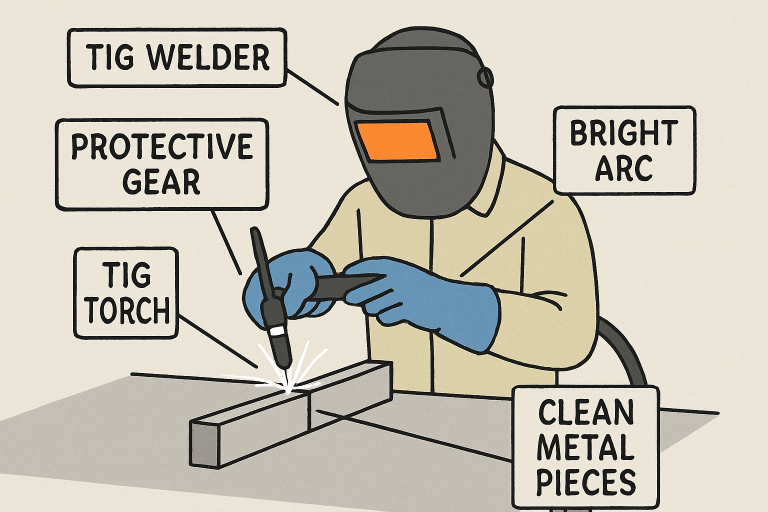
Tungsten Inert Gas (TIG) welding is a crucial metal joining technique in modern fabrication and is known for its accuracy, sophistication, and versatility. It uses a non-consumable tungsten electrode and an inert shielding gas like argon to create clean and consistent welds. It offers high-quality workmanship in critical applications like aerospace, automotive engineering, and custom bicycle and motorcycle fabrication. The Tig Welding Guide provides advice and best practices for novices and experienced professionals. As manufacturing industries adopt more innovative techniques and strive for sustainable practices, TIG welding continues to stand out with clean welds, flexibility, and integration of advanced technologies.
Precision and Quality
TIG welding is a precision and quality welding technique used in various industries, such as aerospace engineering, medical devices, automotive, and motorsport. It uses a non-consumable tungsten electrode under a protective inert gas shield, typically argon, to control heat, movement, and filler material, ensuring welds of exceptional appearance and durability. TIG welding’s fine process management ensures flawless seams, meeting stringent regulatory and quality requirements. In aerospace engineering, medical device, automotive, and motorsport industries, aerospace engineering, medical device, automotive, and motorsport industries, TIG welds are praised for their purity, strength, and polished finish, making it the gold standard for clean, precision welding.
Versatility in Materials
TIG welding is a versatile method that can join various metals and alloys, offering unparalleled results across material types and thicknesses. Its adaptability allows it to work with various metals, presenting unique conductivity, heat sensitivity, and composition challenges conductivity, heat sensitivity, and composition challenges. This flexibility is particularly useful in custom fabrication or prototyping environments, such as bicycle builders, artistic sculptors, and the electronics industry. TIG’s low heat input and fine control make it ideal for circuit boards and delicate assemblies, allowing fabricators to experiment and innovate across applications.
Technological Advancements
Over the past decade, TIG welding has experienced significant technological advancements, transforming its control and applications. Inverter-based TIG machines use advanced electronics to regulate welding variables, allowing operators to adjust arc characteristics for optimal penetration and cleaning effects finely. Pulsed TIG welding technology reduces heat input, enabling deeper penetration on thicker materials. Advanced machines include programmable memory, remote parameter adjustments, and enhanced diagnostics. These advancements have expanded TIG welding’s utility from traditional roles to new digital era applications, extending its utility beyond traditional roles.
Automation in TIG Welding
Automation in TIG welding has significantly improved workplace safety and compensated for the shortage of skilled welders in industrialized nations. Robotic welding arms and cobots perform repetitive TIG welds, ensuring precise, identical joints with unwavering consistency. This enhances efficiency and productivity and allows for creative tasks in smaller fabrication shops. Automation also supports real-time monitoring, quality data capture, and remote diagnostics in smart factories, ensuring the human workforce remains engaged in strategic fabrication.
Environmental Considerations
TIG welding is gaining popularity due to its environmental benefits, including reduced spatter and fume emissions, improved workplace air quality, and reduced energy consumption. Modern inverter-based TIG equipment operates more efficiently, reducing power consumption and carbon footprint. TIG welding is also associated with high material efficiency and uses recyclable inert shielding gases. By adopting advanced TIG processes and equipment, manufacturers can enhance their environmental credentials, reduce hazardous emissions, minimize energy use, and increase productivity, while maintaining uncompromising quality.
Future Trends
TIG welding is undergoing digital transformation, with integrated manufacturing platforms and IoT enabling smart welding systems that monitor processes, provide real-time maintenance, and provide quality assurance feedback. These systems track weld parameters, flag deviations, and provide analytics for continuous improvement. Power source development, including hybrid TIG-MIG capabilities and adaptive inverters, offers flexibility, speed, and operator control. These innovations promise greater energy efficiency and process safety, enabling welders to push boundaries in material thickness, part geometry, and application scenarios. TIG welding technology will continue to shape and empower the fabrication industry.